Back in the 80s, Americans watched as a barge from New York carrying over 3000 tons of garbage was systematically denied offloading up and down the East Coast – all the way to Belize – as media attention grew. Finally, with no other viable option, the trash returned to Brooklyn where it was unceremoniously burned. This event is sometimes credited with the popularization of modern recycling in the US, and the very same year the nation’s first mandatory recycling law was passed in New Jersey.
Recycling in some ways kicked off the environmental movement as an accessible way to make a difference – but does it really? TLDR: it very much can, and in the rest of this write-up I’ll dispel some rumors and talk about how to effectively recycle in Deschutes County.
At its core, recycling exists so we reduce our need to extract additional resources to produce goods. In an ideal “closed loop” system, materials can be separated and remade into useful products again and again. The reality is that most plastics and paper can only be recycled once or twice – but it still significantly reduces extraction of resources and the energy used in production. Metals, however, can be recycled infinitely. As an added benefit, the energy used in the production of a metal product (an aluminum can, for example) is decreased by over 90% when made from recycled material! In one of recycling’s greatest successes, nearly 75% of aluminum ever produced is still in use today. So when you’re done with your beer, make sure that the can ends up in the blue bin.
When I start to talk about waste diversion, sometimes people will object with an oft-repeated point, that our recycling doesn’t actually get recycled, that it ends up on another barge on its way to China to be burned. Don’t get me wrong, our recycling system is far from perfect, but this claim isn’t entirely correct.
Is our recycling often shipped to Chinese recycling centers? Absolutely – China has been using the importation of raw material to help develop its industrial capacity for decades. However, the efficacy of this recycling was questionable due to the levels of contamination that buyers were seeing in the imported raw material (i.e. trash in the recycling). If there was too much trash and not enough recycling, the material wasn’t worth sorting through and it needed to be disposed of. Due to lax environmental regulations and a lack of knowledge on pollution, much of this material ended up in burn piles or in the ocean. In an effort to fix this, China launched its 2017 policy Operation National Sword (which is a sick name) banning certain categories of solid waste in imports and lowered the acceptable plastic waste contamination to 0.05 percent! Because Western countries had municipal recycling streams that were ineffective in preventing contamination, this policy caused a major pileup of recyclables that were eventually disposed of as trash while countries scrambled to improve their recycling efficacy. While this policy has already demonstrated positive impacts on pollution, it resulted in significant – and possibly deserved – bad press for the recycling movement.
Recycling in Deschutes County
Now, recycling isn’t the entire solution to the waste problem we’re experiencing. But the fact is that until we figure out effective methods of prevention (and stop buying disposable plastics), recycling is often our best available option. We have a pretty good system here in Central Oregon – and it will
only get better with the introduction of Oregon’s Recycling Modernization Act. This law expands access to recycling, upgrades sorting facilities, and puts the pressure on producers of packaged items and single use products to pay for it. Importantly, this law also standardizes recyclable materials across all of Oregon, meaning that recycling here is going to be a lot easier to follow. We’re still a year out before this goes into effect, but it’s exciting stuff!
In the meantime, let’s talk about how to recycle in Deschutes County – starting with some confusing items that CANNOT be recycled.
- Frozen food boxes – NO! These are coated with a material that cannot be recycled.
- Coffee cups – NO! Don’t let the recycling symbol fool you!
Tetrapaks (think soy milk) – NO! These must be broken down via a very specific method unavailable in our area.
- Plastic bags or soft plastic – NO! Well, kinda. While soft plastics can’t be put in your curbside bins, grocery bags can sometimes be returned to collection bins at the front of grocery stores. They’re shipped off and made into plastic lumber. Through a partnership with Deschutes Brewery, Mt. Bachelor does our best to separate and recycle clear soft plastics that we collect from departments around the mountain.
And here are some common items that CAN be recycled:
- Most things that come in the mail (newspaper, magazines, paper etc)
- Paper board (cereal and beer boxes)
- Paper bags
- Glass
- Aluminum cans
- Plastic bottles
- Buckets, tubs, and jugs 5 gallons or less
And finally, here are some items that you probably didn’t know you could recycle for free!
- Cooking oil (in a 1-gallon jug with a tight lid)
- Used motor oil
- Automotive batteries
- Paint
Deschutes County Recycling Guide
Republic Services Curbside Recycling Guide
Recycling at the mountain
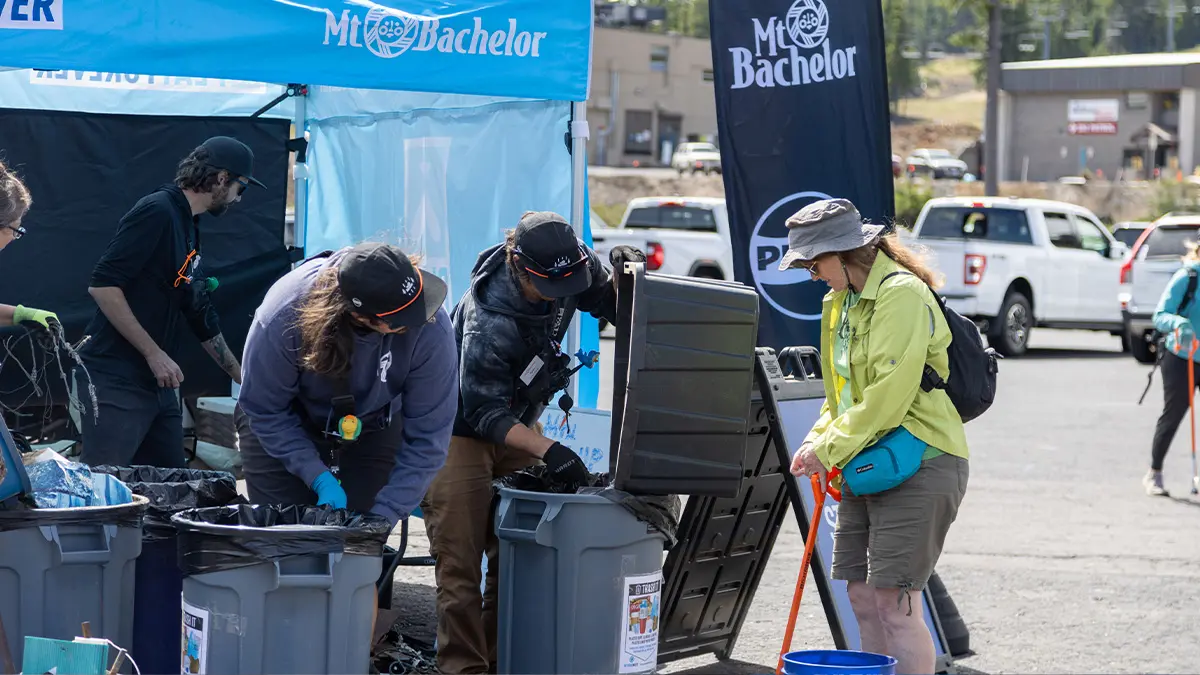
Due to the level of contamination that our recycling bins face, Mt. Bachelor has narrowed our scope to only bottles and cans, which has actually increased how effective we can be. We are working toward providing a bottle+can recycling option at every disposal location around the mountain. When using these, please ensure that your container is empty prior to recycling. We’re still figuring out what works, and we pledge to continually create solutions for the sustainability challenges that we face.